Hypothalamic nonapeptide
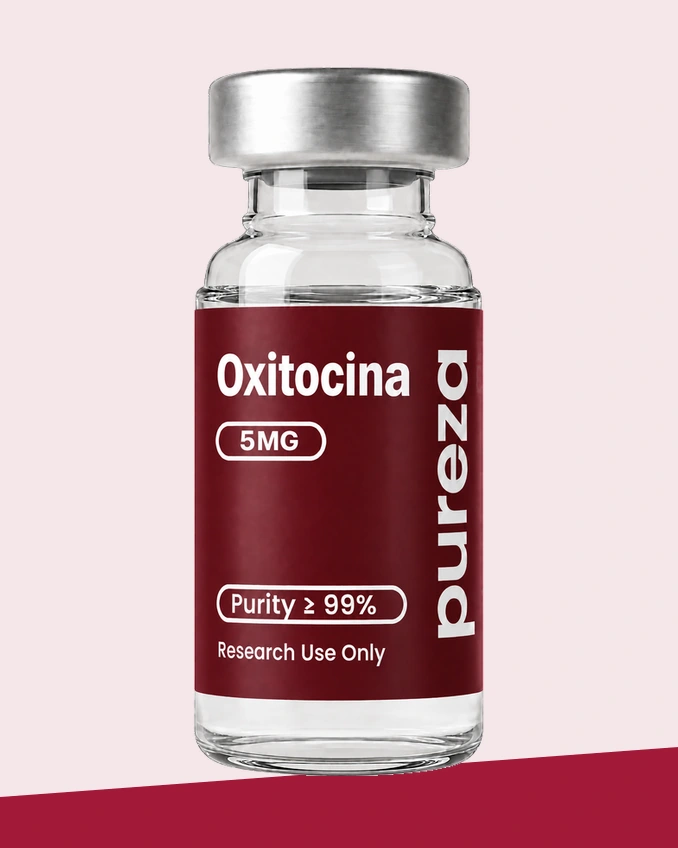
Oxytocin
Oxytocin is a cyclic nonapeptide of hypothalamic origin: six residues form a ring through a disulfide bond between cysteines 1 and 6, followed by a tripeptide tail amidated at the C-terminus. Research literature describes its binding to the oxytocin receptor, a G protein-coupled receptor, and its cross-affinity for vasopressin V1a and V2 receptors. It has been studied in models of neuropeptide signaling in rodent studies.
$990 MXN / unit
Mass: 5 mg
In stock · SKU OXT-05
Prices in Mexican pesos. Cart and secure checkout are currently in Spanish. Shipping and any applicable discounts are shown before payment.
For laboratory research only. Not for human or veterinary use.
Shipping within Mexico · Free from $2,500 MXN.
Shipping protection included: report damage with photos within 24 hours of delivery for one replacement.
Shipping termsResearch context & mechanism
In in vitro studies, oxytocin activates signaling through Gq and members of the Gi/o family via its receptor. Its binding domain shares homology with vasopressin V1a, V1b and V2 receptors, consistent with the cross-affinity described in vitro.
Technical specifications
Reference specifications describe the material. They do not replace the analytical results for a specific batch.
- Chemical name
- Cyclo(1-6)-disulfide of L-cysteinyl-L-tyrosyl-L-isoleucyl-L-glutaminyl-L-asparaginyl-L-cysteinyl-L-prolyl-L-leucyl-glycinamide
- Sequence
- Cys-Tyr-Ile-Gln-Asn-Cys-Pro-Leu-Gly-NH2 (Cys1-Cys6 disulfide bond)
- Molecular formula
- C43H66N12O12S2
- Molecular weight
- 1007.2 Da
- CAS number
- 50-56-6
- Form
- Lyophilized powder
- Appearance
- White to off-white solid
- Purity specification
- Declared in the batch certificate
- Identity
- Declared in the batch certificate
- Solubility
- Soluble in sterile water and bacteriostatic water
- Storage
- −20 °C, protected from light
- Stability after reconstitution
- Keep refrigerated at 2–8 °C and use within the period defined by the laboratory protocol
Batch documentation
Review documentation for the product and variant you are purchasing. A reference specification, a research publication and an individual batch certificate are different sources. Certificate results are accessed with your order details; if documentation is available on request, contact support before relying on it.
Consult batch certificates How to read documentationLaboratory handling
- Reconstitution
- Laboratory procedure: allow the closed vial to reach room temperature, disinfect the septum and slowly transfer the diluent against the inner wall of the vial. Do not shake; gently swirl the vial until fully dissolved. Record the volume, diluent and date in the batch log.
- Storage
- Sealed vial of lyophilized material: store at −20 °C, protected from light and moisture. Avoid repeated freeze-thaw cycles of reconstituted material; aliquot when the experimental design permits.
- Protective equipment
- Handle in a clean work area with a lab coat, nitrile gloves and eye protection. Dispose of vials, tips and sharps according to the laboratory waste procedure.
Frequently asked questions
How is Oxytocin supplied?
Oxytocin is supplied in a sealed vial containing the quantity indicated for the selected variant, with its batch identifier printed on the label.
How is Oxytocin stored in the laboratory?
Store the closed vial at −20 °C, protected from light and moisture. See the laboratory handling section of this page for the complete procedure.
Which molecular form corresponds to the declared formula and mass?
The data on this page correspond to the oxidized cyclic form, with the Cys1-Cys6 disulfide bond closed: formula C43H66N12O12S2 and average mass 1007.2 Da, according to PubChem CID 439302. The reduced linear form, with two free thiols, has a higher mass and is not the value against which a certificate for this product is compared.
What additional laboratory precaution does the disulfide bond require?
Reduction of the disulfide bond and degradation of oxytocin in solution are different processes. Chemical studies describe a dithiol form as well as degradation pathways with different products, whose occurrence depends on experimental conditions. For this reason, the reconstituted material is not combined with diluents containing free thiols and is aliquoted according to the laboratory procedure.
Why does this page mention vasopressin receptors?
Because the oxytocin receptor and vasopressin V1a, V1b and V2 receptors share homology in their binding domain, the in vitro literature describes cross-affinity among them. This is information about receptor-system selectivity, not a claim about any effect.
Related research materials