Neuroactive compound
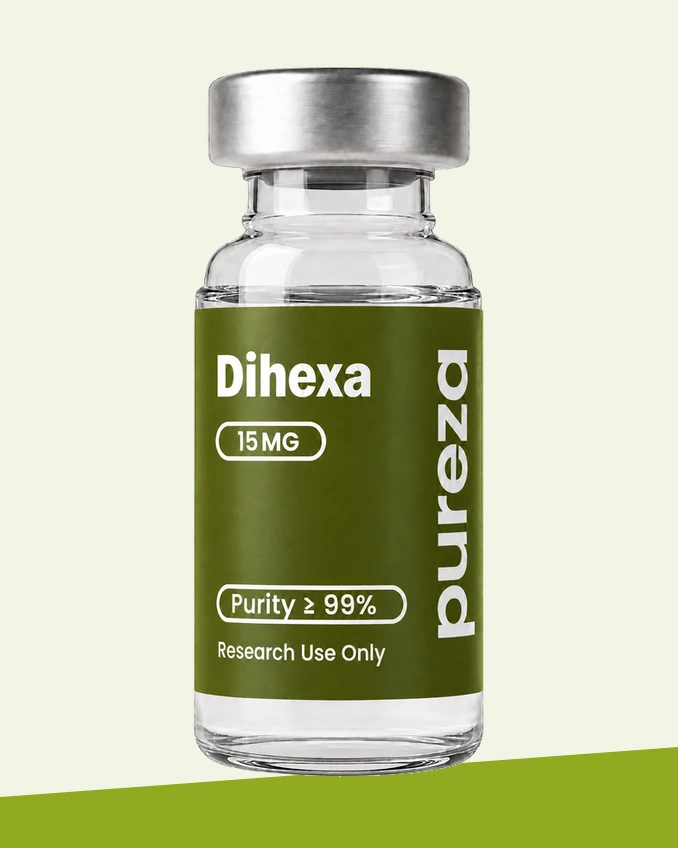
Dihexa
Dihexa, also called PNB-0408, is a synthetic angiotensin IV analog. It has been studied in preclinical models with results that differ between models. Its bibliography includes an editorial expression of concern about the initial characterization and the retraction of a mechanistic article.
$2,290 MXN / unit
Mass: 15 mg
In stock · SKU DHX-15
Prices in Mexican pesos. Cart and secure checkout are currently in Spanish. Shipping and any applicable discounts are shown before payment.
For laboratory research only. Not for human or veterinary use.
Shipping within Mexico · Free from $2,500 MXN.
Shipping protection included: report damage with photos within 24 hours of delivery for one replacement.
Shipping termsResearch context & mechanism
The proposed interaction with the HGF/c-Met system comes, in part, from an article retracted in 2025. In preclinical models, another study examined the involvement of PI3K/AKT; that finding does not, by itself, confirm the proposed molecular interaction.
Technical specifications
Reference specifications describe the material. They do not replace the analytical results for a specific batch.
- Chemical name
- N-hexanoic-L-tyrosyl-L-isoleucyl-(6)-aminohexanoic amide
- Sequence
- Not available
- Molecular formula
- Not available
- Molecular weight
- Not available
- CAS number
- Not available
- Form
- Lyophilized powder
- Appearance
- White to off-white solid
- Purity specification
- Declared in the batch certificate
- Identity
- Declared in the batch certificate
- Solubility
- Soluble in sterile water and bacteriostatic water
- Storage
- −20 °C, protected from light
- Stability after reconstitution
- Keep refrigerated at 2–8 °C and use within the period defined by the laboratory protocol
Batch documentation
Review documentation for the product and variant you are purchasing. A reference specification, a research publication and an individual batch certificate are different sources. Certificate results are accessed with your order details; if documentation is available on request, contact support before relying on it.
Consult batch certificates How to read documentationLaboratory handling
- Reconstitution
- Laboratory procedure: allow the closed vial to reach room temperature, disinfect the septum and slowly transfer the diluent against the inner wall of the vial. Do not shake; gently swirl the vial until fully dissolved. Record the volume, diluent and date in the batch log.
- Storage
- Sealed vial of lyophilized material: store at −20 °C, protected from light and moisture. Avoid repeated freeze-thaw cycles of reconstituted material; aliquot when the experimental design permits.
- Protective equipment
- Handle in a clean work area with a lab coat, nitrile gloves and eye protection. Dispose of vials, tips and sharps according to the laboratory waste procedure.
Research references
- The development of small molecule angiotensin IV analogs to treat Alzheimer's and Parkinson's diseases
Prog Neurobiol · 2015 · PMID 25455861
- Cognitive benefits of angiotensin IV and angiotensin-(1-7): A systematic review of experimental studies
Neurosci Biobehav Rev · 2018 · PMID 29733881
- Effects of an Angiotensin IV Analog on 3-Nitropropionic Acid-Induced Huntington's Disease-Like Symptoms in Rats
J Huntingtons Dis · 2024 · PMID 38489193
- AngIV-Analog Dihexa Rescues Cognitive Impairment and Recovers Memory in the APP/PS1 Mouse via the PI3K/AKT Signaling Pathway
Brain Sci · 2021 · PMID 34827486
- Stem cell, Granulocyte-Colony Stimulating Factor and/or Dihexa to promote limb function recovery in a rat sciatic nerve damage-repair model: Experimental animal studies
Ann Med Surg (Lond) · 2021 · PMID 34703584
- Hepatocyte growth factor mimetic protects lateral line hair cells from aminoglycoside exposure
Front Cell Neurosci · 2015 · PMID 25674052
Frequently asked questions
How is Dihexa supplied?
Dihexa is supplied in a sealed vial containing the quantity indicated for the selected variant, with its batch identifier printed on the label.
How is Dihexa stored in the laboratory?
Store the closed vial at −20 °C, protected from light and moisture. See the laboratory handling section of this page for the complete procedure.
Related research materials